Andrea Neyra-Nazarrett

Research

My research is in organizational and personnel economics, studying how managers, organizational design, and firm practices shape productivity inside firms — with applications to public policy.

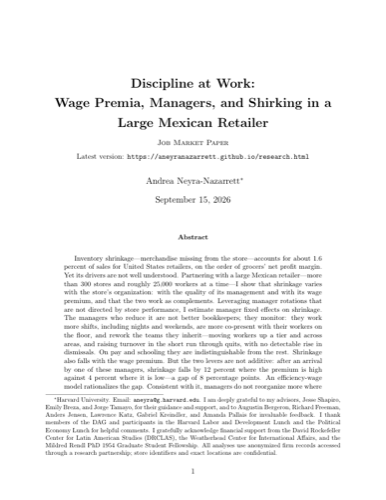
Job Market Paper

Working Papers

  • paper first page

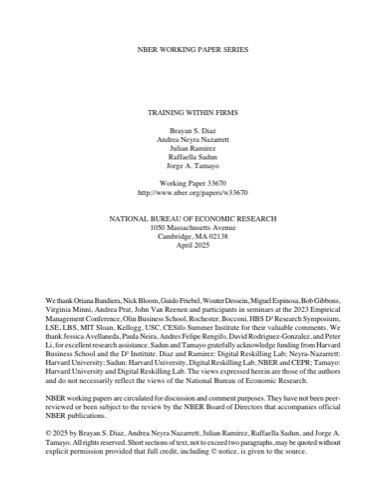
    Training Within Firms

    with Brayan Diaz, Julian Ramirez, Raffaella Sadun, and Jorge Tamayo  ·  NBER Working Paper No. 33670 · HBS Working Paper 25-045

    Training investments are essential for improving worker and firm productivity, yet their implementation is often hindered by low participation rates and insufficient worker engagement. This study uses data from three firms—a car manufacturer, a quick-service restaurant chain, and a retail company—to show that variation in training participation among employees is closely tied to differences in middle managers’ behavior and practices. Middle managers who actively engage with their employees and emphasize their well-being and development are associated with significantly higher participation in training programs. These managerial differences significantly influence employee performance and absenteeism, especially during periods of organizational change. Together, these findings underscore the importance of middle managers in bridging the gap between centrally designed HR policies and their effective on-the-ground execution.

    Media: Featured in HBS Working Knowledge“The ‘Secret Ingredient’ for Effective Training: Middle Managers” (2025).

  • paper first page

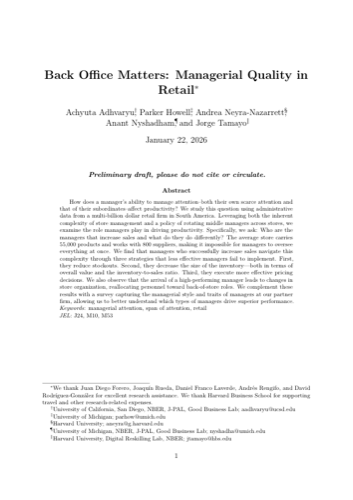
    Back Office Matters: Managerial Quality in Retail

    with Achyuta Adhvaryu, Parker Howell, Anant Nyshadham, and Jorge Tamayo

    How does a manager’s ability to manage attention–both their own scarce attention and that of their subordinates–affect productivity? We study this question using administrative data from a multi-billion dollar retail firm in South America. Leveraging both the inherent complexity of store management and a policy of rotating middle managers across stores, we examine the role managers play in driving productivity. Specifically, we ask: Who are the managers that increase sales and what do they do differently? The average store carries 55,000 products and works with 800 suppliers, making it impossible for managers to oversee everything at once. We find that managers who successfully increase sales navigate this complexity through three strategies that less effective managers fail to implement. First, they reduce stockouts. Second, they decrease the size of the inventory—both in terms of overall value and the inventory-to-sales ratio. Third, they execute more effective pricing decisions. We also observe that the arrival of a high-performing manager leads to changes in store organization, reallocating personnel toward back-of-store roles. We complement these results with a survey capturing the managerial style and traits of managers at our partner firm, allowing us to better understand which types of managers drive superior performance.

  • paper first page

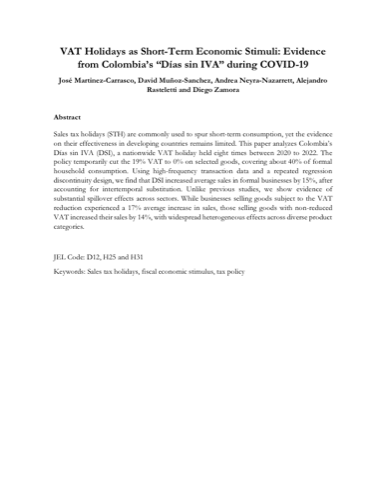
    VAT Holidays as Short-Term Economic Stimuli: Evidence from Colombia’s “Días sin IVA” during COVID-19

    with José Martinez-Carrasco, David Muñoz-Sanchez, Alejandro Rasteletti, and Diego Zamora  ·  IDB Working Paper

    Sales tax holidays (STH) are commonly used to spur short-term consumption, yet the evidence on their effectiveness in developing countries remains limited. This paper analyzes Colombia’s Días sin IVA (DSI), a nationwide VAT holiday held eight times between 2020 to 2022. The policy temporarily cut the 19% VAT to 0% on selected goods, covering about 40% of formal household consumption. Using high-frequency transaction data and a repeated regression discontinuity design, we find that DSI increased average sales in formal businesses by 15%, after accounting for intertemporal substitution. Unlike previous studies, we show evidence of substantial spillover effects across sectors. While businesses selling goods subject to the VAT reduction experienced a 17% average increase in sales, those selling goods with non-reduced VAT increased their sales by 14%, with widespread heterogeneous effects across diverse product categories.

  • Work in Progress

    Managing Shrinkage

    with Jorge Tamayo