Andrea Neyra-Nazarrett
PhD Candidate in Political Economy and Government (Economics Track), Harvard University

I am a PhD candidate in Political Economy and Government at Harvard University, working in labor, organizational, and personnel economics. I study how wages, managers, and firm practices shape worker effort and productivity, using large unstructured data. I am affiliated with the Weatherhead Center for International Affairs, the Center for International Development at Harvard Kennedy School, the Digital Reskilling Lab at the Harvard Business School AI Institute, the Institute for Quantitative Social Science (IQSS), and the David Rockefeller Center for Latin American Studies (DRCLAS).
I am on the 2026–2027 academic job market.
Before my doctoral studies I earned an MPP from the Harvard Kennedy School, where I was a Fulbright–García Robles Scholar, and a BA in Economics from ITAM (Instituto Tecnológico Autónomo de México). I previously worked as a research assistant at the World Bank and the Inter-American Development Bank.
I am originally from Toluca, Mexico. Outside of research, I run marathons, swim in open water, and read widely about what makes workers and organizations productive. I am always happy to trade book recommendations.
Job Market Paper
-
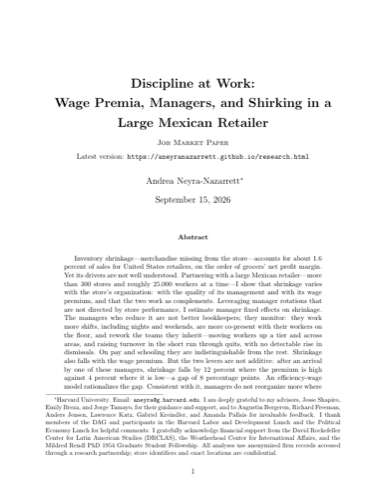
Managers, Wage Premia, and Worker Effort: Evidence from a Large Retailer
Job Market PaperLatest version (PDF) · October 2026 draft
I study managerial monitoring and wage premia as levers to incentivize worker effort in the firm. Using administrative records from a large retailer, I show how the two jointly deter inventory shrinkage, merchandise missing from the store. Exploiting the rotation of managers across stores, I estimate each manager's effect on shrinkage and document what high-type managers do when they arrive at a store. They are not better bookkeepers. They work more shifts, including nights and weekends, spend more time on the floor with their workers, and rework the teams they inherit, yet on demographic characteristics they are indistinguishable from other managers. Leveraging a company policy that sets wages centrally by position, I document that shrinkage also falls with the wage premium. The two levers reinforce each other: the arrival of a good manager reduces shrinkage by 8 percent more where the premium is high. Good managers suspend more workers during high-wage-premium periods.
Working Papers
-
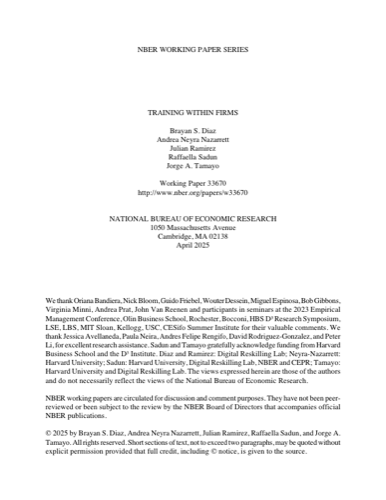
Training Within Firms
with B. Diaz, J. Ramirez, R. Sadun, and J. Tamayo · NBER Working Paper No. 33670 · Presented at NBER SI 2024 (Personnel Economics) · Covered in HBS Working Knowledge
Training investments are essential for improving worker and firm productivity, yet their implementation is often hindered by low participation rates and insufficient worker engagement. This study uses data from three firms (a car manufacturer, a quick-service restaurant chain, and a retail company) to show that variation in training participation among employees is closely tied to differences in middle managers’ behavior and practices. Middle managers who actively engage with their employees and emphasize their well-being and development are associated with significantly higher participation in training programs. These managerial differences significantly influence employee performance and absenteeism, especially during periods of organizational change. Together, these findings underscore the importance of middle managers in bridging the gap between centrally designed HR policies and their effective on-the-ground execution.
-
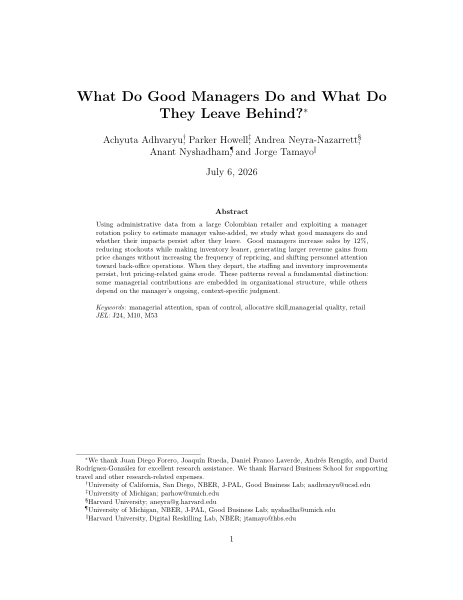
What Do Good Managers Do and What Do They Leave Behind?
with A. Adhvaryu, P. Howell, A. Nyshadham, and J. Tamayo · Presented at NBER SI 2025 (Personnel Economics)
Using administrative data from a large Colombian retailer and exploiting a manager rotation policy to estimate manager value-added, we study what good managers do and whether their impacts persist after they leave. Good managers increase sales by 12%, reducing stockouts while making inventory leaner, generating larger revenue gains from price changes without increasing the frequency of repricing, and shifting personnel attention toward back-office operations. When they depart, the staffing and inventory improvements persist, but pricing-related gains erode. These patterns reveal a fundamental distinction: some managerial contributions are embedded in organizational structure, while others depend on the manager’s ongoing, context-specific judgment.
More about my research →